I used to believe that the heart of medicine lived entirely in the “hunch.” In the early years of my career, I prided myself on my intuition, the ability to walk into a room, look a patient in the eye, and feel the weight of their diagnosis before the lab results even hit my desk. There is an undeniable romance in the “art” of healing, the idea that experience and a gut feeling are the primary tools of a great provider.
But then I saw the limitations of the human mind. I saw how easily a busy shift, a lack of sleep, or a subtle cognitive bias could cloud that intuition. I saw patients who were “falling through the cracks” because their symptoms didn’t fit the classic textbook definition I had memorized.
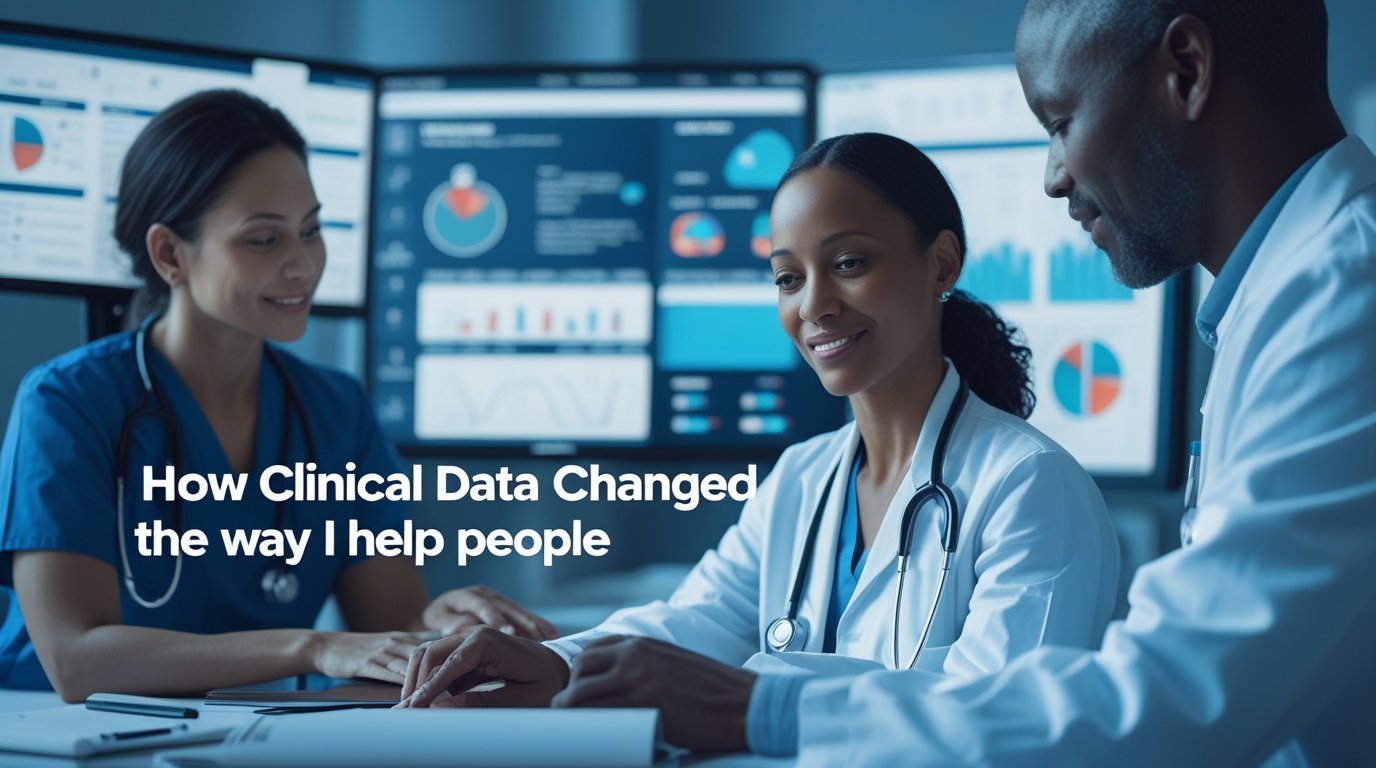
My entire philosophy of care shifted when I began to embrace Clinical Data. I realized that data isn’t just a collection of cold, hard numbers on a spreadsheet; it is the “Collective Voice” of millions of patients. It is a map that shows us where the hidden dangers lie. Here is how clinical data transformed my approach from a reactive “hunch” to a proactive, life-saving strategy.
1. The Death of “Anecdotal Evidence.”
For a long time, I operated on what I call “The Last Patient I Saw” bias. If I saw a rare reaction to a medication on Tuesday, I was subconsciously terrified of prescribing that same medication on Wednesday, even if it was the best choice for the new patient. This is the danger of anecdotes; they are powerful, but they are often statistically insignificant.
When I started using Real-Time Clinical Analytics, the fog lifted. Instead of relying on my memory of three or four similar cases, I could look at the data from three or four thousand cases.
I learned that clinical data provides a “Shared Wisdom” that no single human could ever achieve. It taught me to trust the patterns over the outliers. This didn’t make me less compassionate; it made me more accurate. It allowed me to tell a patient with total confidence: “Based on the data of people with your exact profile, this is our highest-probability path to success.”
2. Detecting the “Invisible” Crisis: Sepsis and Data:
If you’ve spent any time in a hospital, you know the word “Sepsis” is the stuff of nightmares. It is a silent, rapid killer that can turn a stable patient into a critical emergency in a matter of hours. Traditionally, we waited for the “Signs”, the fever, the plummeting blood pressure, the confusion. But by the time those signs are visible to the human eye, the damage is often already done.
Clinical data changed how I help people by giving me an Early Warning System.
I recall a specific patient who looked perfectly fine to me during my morning rounds. They were sitting up, eating breakfast, and chatting. However, the Clinical Decision Support system flagged them with a “Red” score. The data, the subtle upward creep of the heart rate, the slight dip in urine output, and a minute change in white blood cell count, saw the sepsis before I did.
Because we trusted the data over my “hunch” that the patient looked “fine,” we started antibiotics and fluids immediately. By that evening, the patient was stable. Without that data, I would have waited until they were in shock. Data gave that patient a future that my intuition might have missed.
3. The Power of “Population Health” in Individual Care:
I used to think that “Public Health” was something for government officials in high-rise offices, and “Clinical Care” was what happened in my exam room. Clinical data bridged that gap for me through the lens of Population Health Management.
By looking at the data of my entire patient panel, I stopped being a “Reactive Firefighter” and started being a “Proactive Architect.” I could suddenly see the “Gaps in Care” that are impossible to spot one-on-one.
- I could see that 15% of my diabetic patients hadn’t had an eye exam in two years.
- I could identify which elderly patients were on “High-Risk” medication combinations.
- I could track which demographic was struggling with “Medication Adherence.”
This data changed my daily workflow. Instead of waiting for these people to show up in the ER with a complication, I started reaching out to them. We began “Pre-emptive Care.” This shift moved the goalpost of my career: I wasn’t just helping people “get better”; I was helping them “stay well.”
4. Personalized Medicine: The “N-of-1” Data Set:
The most exciting transformation I’ve experienced is the move toward Precision Medicine. For decades, medicine has been “Average-Based.” We give the “average” dose of the “average” drug to the “average” person. But nobody is actually average.
Clinical data, specifically genomic data and biometric tracking, allows me to treat the “Unique Biology” of the person standing in front of me. I’ve had patients who struggled for years with standard treatments for depression or hypertension. By looking at their Pharmacogenomic Data, we discovered that their bodies literally couldn’t process the “standard” medications.
Data allowed me to stop the “Trial and Error” phase of medicine. We went straight to the solution that their specific DNA required. This is the ultimate form of “Helping People”, removing the years of frustration and side effects by using data as a biological compass.
5. Reducing “Provider Bias” and Ensuring Equity:
This is a difficult truth to admit, but as humans, we all carry implicit biases. Studies have shown that pain is often under-treated in certain demographics, or that women’s symptoms are sometimes dismissed as “anxiety.”
Clinical data acts as a Neutral Arbiter. The data doesn’t know the patient’s race, gender, or socioeconomic status; it only knows the physiological reality.
By using data-driven protocols, I’ve been able to audit my own care. I can look at the “Outcomes Data” for my practice and ensure that every patient, regardless of their background, is receiving the same high standard of care. Data has made me a more “Just” provider. It has forced me to look at the cold, hard facts of my performance and strive for a level of equity that intuition alone could never guarantee.
6. The “Human” Side of High-Tech Data:
There is a fear in our industry that data will “Dehumanize” the patient, that we will stop seeing “Mr. Jones” and start seeing “Subject #445.”
I found the opposite to be true. Because the clinical data handles the “Number Crunching,” the “Trend Tracking,” and the “Protocol Checking,” I actually have More Time to be human.
When I walk into a room now, I’m not spending twenty minutes hunting through a paper chart to find a lab result. I already have the insights. I can spend that time looking at Mr. Jones, asking about his grandchildren, and discussing his quality of life. Data has automated the “Administrative Mind,” which has freed up the “Compassionate Heart.”
Conclusion:
If you had told me twenty years ago that I would be obsessed with data sets and predictive algorithms, I would have laughed. I thought the “Magic” of medicine was in the mystery.
But I’ve learned that the true magic is in the Certainty. I help people more effectively today because I am standing on the shoulders of millions of data points. I am no longer guessing. I am navigating.
Clinical data has changed healthcare from a “Game of Chance” into a “Science of Success.” It hasn’t replaced my stethoscope, but it has certainly given me a much clearer way to hear what the patient’s body is trying to say. We are no longer limited by what one person can know; we are empowered by what all of us know.
FAQs:
1. Is “Data-Driven” care just “Robotic” medicine?
Absolutely not; it is about using the best available evidence to support human judgment, not replace it.
2. How does clinical data help with “Rare Diseases”?
It allows providers to connect with global databases to find “Pattern Matches” that they might never see in their local practice.
3. Is my data safe in these large clinical sets?
Yes, clinical data used for research and population health is “De-identified,” meaning your personal identity is removed before analysis.
4. Does data actually reduce healthcare costs?
Yes, by preventing “Adverse Events,” reducing “Readmissions,” and stopping “Unnecessary Testing.”
5. Can I see my own “Clinical Data”?
Most modern systems provide this through “Patient Portals,” allowing you to track your own trends and be an active partner in your care.
6. What happens if the data is wrong?
Data is a tool, not a god. Clinical judgment always remains the final authority; the data is there to “Advise,” but the provider “Decides.”